




 08:38 2026-08-19
Imagine buying a length of cloth in the 15th century. The seller swears he measured exactly three ells. How could you verify the claim? Medieval trading towns had an elegant, harsh answer: they cut, cast, and forged official standards of measure and weight into the walls of town halls and cathedrals. Any buyer could instantly check a merchant's honesty. A market with a reputation for fairness drew traders from across the continent. Those iron and stone rulers survive on the facades of old buildings to this day.
 738
738 7
7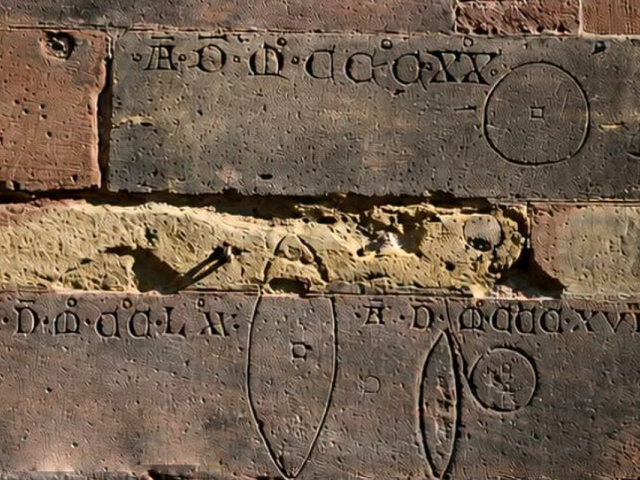
Nuremberg —motto on scales
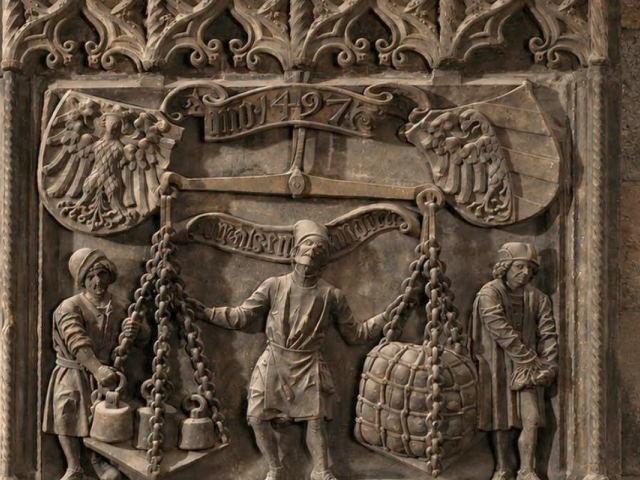
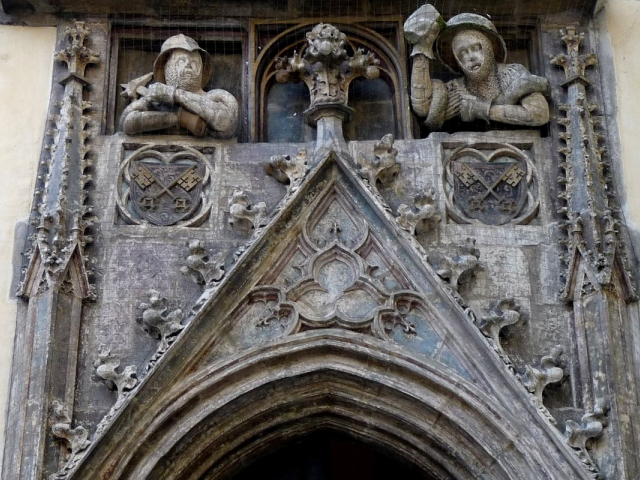
The medieval concept of fair trade is best summed up by the inscription on the relief of the Nuremberg city scales: “The same for you as for another.” Cities such as Nuremberg, Bruges, and Lübeck fiercely competed for rich merchant caravans. If word spread that a city’s market habitually cheated with false measures, merchants simply rerouted and denied the city large customs revenues. Public standards and an equal approach to all customers were therefore not charity but a deliberate, hard economic strategy.
Freiburg — bread cut in stone
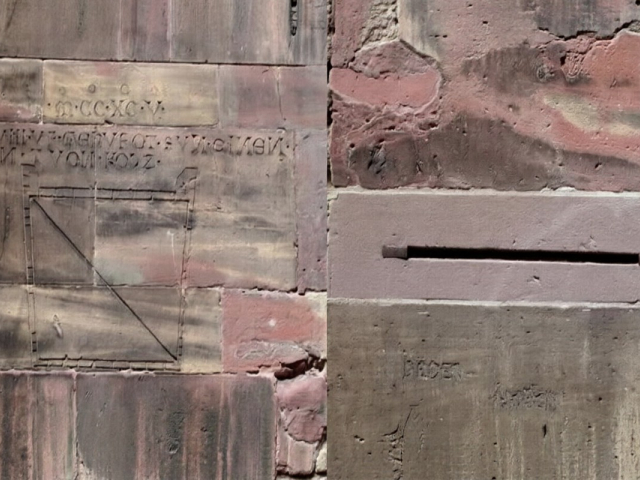
On the northwest tower of Freiburg Cathedral, unusual silhouettes are cut into the stone: outlines of loaves. Dates nearby speak for themselves: 1270, 1317, and 1320. These were legally sanctioned loaf sizes. In poor years, the city authorities refused to raise the fixed price of bread. Instead of inflation, they reduced the size of the loaf, chiseling a new outline on the cathedral as the standard. A baker who sold a loaf smaller than the carved standard faced severe punishment. Citizens always knew the exact size of their daily ration.
Regensburg —iron trio
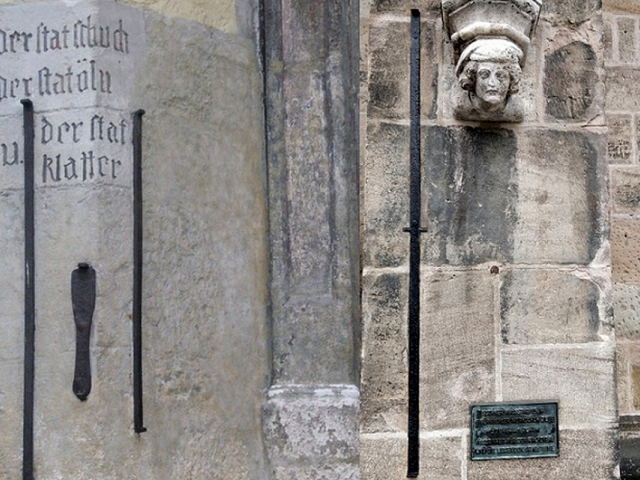
At the main entrance to Regensburg’s town hall, to the left of the portal, the city’s 15th‑century measures of length are forged into metal. Here are the official standards: the Schuh (city foot, about 31 cm), the Elle (ell, listed here as 83 cm) and the Klafter (fathom — a reach of nearly two meters). A Gothic inscription above confirms their official status. Any merchant had to check his measures against this strict public reference on the street. Against such an iron argument, a crooked trader had no chance, and the city secured fair deals.
Hildesheim —ell on chain
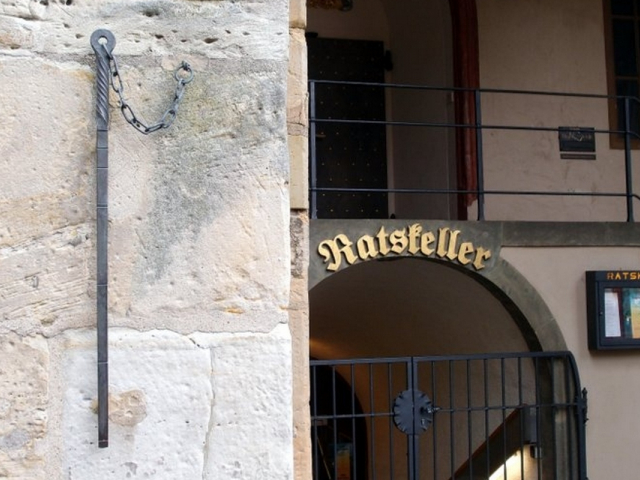
On Hildesheim’s main market square, at the very entrance to the town hall, an iron rod hangs on a massive chain. This is the legendary “Hildesheim ell” — the principal standard for all cloth and fabric traders in the region. If a buyer had doubts, they simply took the cut to the town hall and measured it against the permanent iron ruler. Having a fixed standard chained in public removed any opportunity for trickery and made Hildesheim one of Europe’s most attractive trading hubs.
London —bronze standard of Guildhall
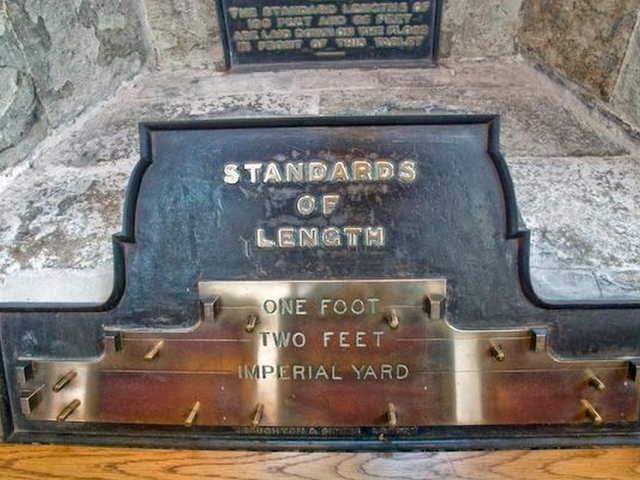
The English capital treated standardization with equal reverence. In the Guildhall, which served as the London City town hall from the 12th century, bronze Standard Measures are embedded in the stone floor. Before the Great Fire of London, a “St. Paul’s foot” standard was carved on one of St. Paul’s Cathedral's columns. That standard of length was regarded as the chief legal reference for late medieval England. Checking measures in the cathedral or the town hall was a required ritual before major wholesale deals.
Sester, Zuber, Elle — measures under holy protection
Besides the bread standards on Freiburg Cathedral’s wall are other measures. The Elle of 54 centimeters is carved in stone there, and a square recess, the Sester, serves as the standard for dry grain measuring almost 23 liters. Slightly higher is the Zuber—a deep double‑walled vessel that helped convert flat measures into volumes. The cathedral was chosen deliberately. Merchants weighed and measured their goods under the watch of both civic authority and sacred power. Cheating “in the face” of such religious authority was tantamount to sacrilege.
Hidden legacy — metal instead of words
Remarkably, most of these medieval control devices survived wars, fires, and centuries and still sit on the facades of European town halls and cathedrals. Today, thousands of tourists pass them daily, mistaking iron strips for bits of old grating and stone recesses for weather damage. In fact, these are unique historical monuments—the world’s first consumer protection tools. They silently remind us of eras when a seller’s verbal promise meant nothing without a touch of the cold metal city standard.


-
Grand Choice
Contest by
InstaForexInstaForex always strives to help you
fulfill your biggest dreams.JOIN CONTEST -
Chancy DepositDeposit your account with $3,000 and get $1000 more!
In October we raffle $1000 within the Chancy Deposit campaign!
Get a chance to win by depositing $3,000 to a trading account. Having fulfilled this condition, you become a campaign participant.JOIN CONTEST -
Trade Wise, Win DeviceTop up your account with at least $500, sign up for the contest, and get a chance to win mobile devices.JOIN CONTEST


